In This Article
I've spent my career crossing back and forth between startups and big companies. Each time I switched, I thought I knew what I was getting into. I was always wrong -- and those surprises taught me more than any playbook ever could.
From CEO Access to Corporate Politics: My Big Company Reality Check
Before working at large companies, I worked in a series of startups. That transition was really hard for me. Coming from a world where I could go in and talk to the CEO any time I wanted, it was the work that mattered. Seeing the business succeed was all we cared about. There wasn't time for politics or bureaucracy because survival depended on delivering value quickly and efficiently. In the startup world, we wore multiple hats, even if I didn't know what I was doing, because there wasn't anyone else to wear them. I did marketing, public relations, systems design, UX design, basic coding, customer service, sales, and more. It was fun, but often half-baked.
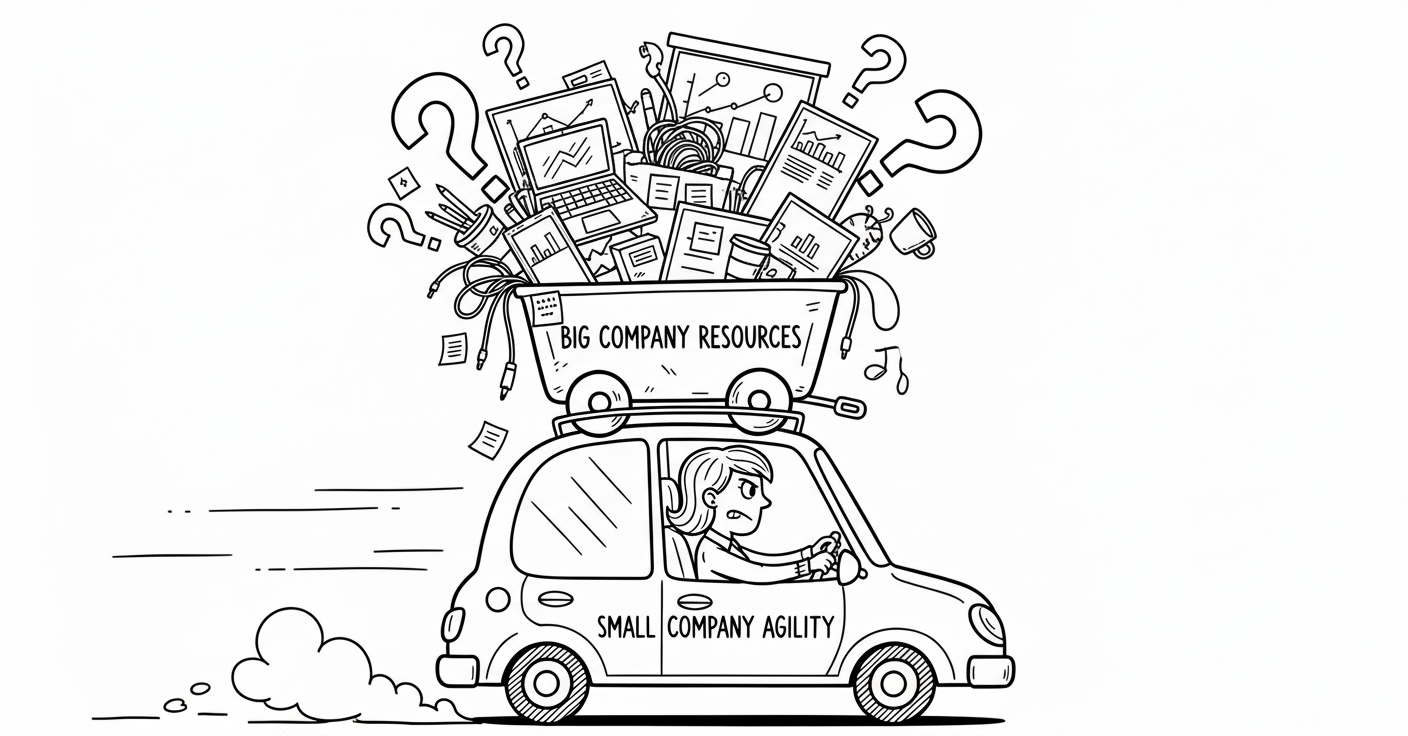
But when I went to the big companies, I had to adapt if I was going to survive and thrive. At first, the exposure to the experts and resources was amazing. I got to work alongside real customer researchers who knew what they were doing. I got to work with real enterprise architects and huge development teams and learn how to really scale a global company. I got to work with vast sales teams, killer marketing teams, thoughtful UX and design teams, provocative public relations teams, and I could learn from all of them. In the past, I just made things up along the way. Now I could discover best practices from people who had perfected their crafts.
But there was also a darker side that I had to learn. I was often up against people for resources, influence, and promotions who had grown up in the big companies. They knew how to play the game. But instead of being threatened by them or complaining, I tried to learn everything I could from them. For example, I watched my manager spend 50% of his time 'selling' our team's products, services, initiatives, and capabilities across the organization. It wasn't enough that we had a better platform solution. We had to earn trust and build a reputation to gain adoption. I would watch as product managers would pitch new ideas and get support, or get resisted, or get ignored. And I learned from their successes and failures as well, and I started to realize how confidence was often more important than competence or results. So I started to work on showing off more (although I never did master that one).
This big company experience helped me appreciate that there's a different set of rules for getting things done when you're part of a big organization. Those who learn the rules get ahead. Those who do not will get eaten up and spit out.
The Hybrid Takeaway
What all these experiences taught me is that neither world is better -- they're different games with different rules, and the real advantage comes from having played both. Once you learn how to thrive in a big organization, you benefit from its scale and resources. Your influence grows and your wins pile up. And if you leave? That experience travels with you. Move back to a startup in B2B and you'll have gained a whole new level of empathy and insight into your customers. It will make your sales calls and customer research at least 2x better.
The best organizations don't treat startup and enterprise approaches as mutually exclusive. They optimize based on context: startup methods when speed matters most, enterprise capabilities when systematic approaches create value.
Looking back, watching my manager spend half his time selling internally was one of the most valuable lessons of my career. It taught me that great work doesn't speak for itself -- you have to learn how to speak for it. That's a startup founder's instinct applied inside a big company, and it's the kind of hybrid thinking that only comes from living in both worlds.

Nathan Rohm
Product Leadership & Innovation Expert
Nathan Rohm is a product leader with 25+ years of experience transforming organizations through strategic innovation. He has scaled products from $5M to $150M, achieved 2,000% growth rates, and built teams that deliver results across startups and Fortune 500 companies.
Get in Touch