In This Article
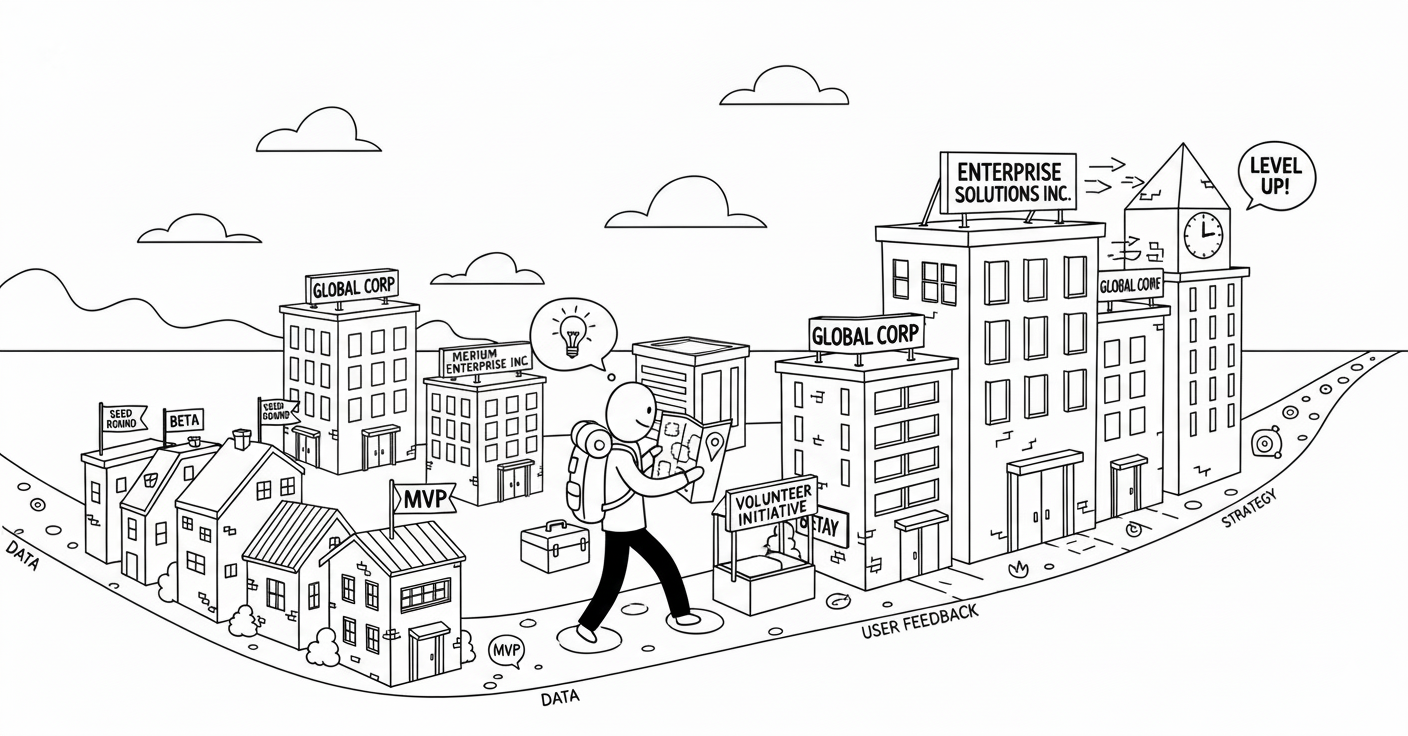
After decades building products in both startups and Fortune 500 companies, I've found that each environment has blind spots the other naturally corrects. Startups mistake speed for strategy; enterprises mistake process for progress. The best product managers learn to carry lessons from both worlds and apply the right approach in the right context.
When Speed Meets Analysis Paralysis
At one of my early startups, we were launching a new feature for our coaching marketplace. The team sketched out a solution on a whiteboard and had it coded within two weeks. Were we right? Partially. But we learned quickly through real user feedback.
Fast forward to my time leading product at a large travel company, where decisions affected millions of users and billions in revenue. When considering changes to the hotel content experience, we could run controlled experiments with statistical significance, analyze behavior patterns across 50+ international markets, and make data-driven decisions with confidence.
The crossover moment came when I realized both approaches had critical flaws. Big companies spend months researching what a startup would test in weeks. Startups repeatedly make preventable mistakes that proper data analysis would catch immediately.
The Skills Transfer Challenge
From Enterprise to Startup: The Certainty Trap
Enterprise-trained PMs often fall into what I call the "certainty trap." I remember working with one talented PM from a large software company. "Let me run some customer interviews first," became his default response to every decision. After three months of "research," I knew I could have built and tested four different solutions at a startup.
Startups operate where complete information doesn't exist. You have to get comfortable making decisions with 40-60% certainty and iterating based on results.
From Startup to Enterprise: The Coalition Building Gap
One startup PM I mentored kept bypassing established approval processes, thinking it was useless bureaucratic overhead. I tried to warn her, but she didn't understand that in large organizations, the "process people" have significant power. She never needed coalition-building skills at her 15-person startup. Getting shut down and de-resourced is a hard way to learn the value of building organizational momentum for your work along the way.
Real-World Applications
Bringing Startup Speed to Enterprise
During my time as Director of Product Management, for one critical platform update, rather than going through the traditional 12-week planning cycle, I formed an informal cross-functional team of 8 people who could operate with startup-like autonomy.
We validated our approach in a month instead of a quarter, and the success influenced how other teams approached similar challenges. The key was understanding which decisions truly required enterprise-level process and which could benefit from startup-speed execution. It was also in creating a team where everyone owned the success of the effort, so they all did what was necessary to make things happen.
Applying Enterprise Rigor to Startups
At one startup struggling with repeated failed launches, I introduced lightweight versions of enterprise practices:
- Hypothesis-driven development: Clear hypotheses with success criteria instead of building features that "seemed right"
- Staged rollouts: Controlled rollouts to catch issues early rather than launching to all users simultaneously
- Cross-functional alignment: Brief daily meetings to prevent communication breakdowns
These enterprise-inspired practices didn't slow down the startup. They accelerated learning and reduced waste.
The real skill isn't mastering one environment or the other -- it's developing the judgment to know which approach fits the moment. Speed without rigor is reckless; rigor without speed is irrelevant. The PMs who create the most impact are the ones who can read the situation and pull from the right playbook, regardless of where they learned it.

Nathan Rohm
Product Leadership & Innovation Expert
Nathan Rohm is a product leader with 25+ years of experience transforming organizations through strategic innovation. He has scaled products from $5M to $150M, achieved 2,000% growth rates, and built teams that deliver results across startups and Fortune 500 companies.
Get in Touch